Myths, words and naturalists
From a Greek weaver to a West African storyteller, and from Victorian spider books to a 2018 lab experiment.
Arachne
In Greek myth, Arachne was a weaver so skilled that she challenged the goddess Athena, and the two of them each wove a tapestry. She was turned into a spider. Britannica: Arachne The main source for the story is the Roman poet Ovid’s Metamorphoses. Britannica: Arachne
Her name gave us Arachnida, the scientific name of the class that spiders belong to. Britannica: Arachne
The words
The English word ‘spider’ comes from Middle English spyder, related to the Old English word spinnan, ‘to spin’. It was first used in the 15th century. Merriam-Webster: spider
‘Arachnid’ comes from the Greek aráchnē, meaning ‘spider’ or ‘spiderweb’, and its first known use in English was in 1826. Merriam-Webster: arachnid The French name arachnide was introduced by Lamarck in 1801. Merriam-Webster: arachnid
Anansi
West African stories tell of Anansi, a spider. Burke Museum, Seattle: Spider myths (by its spider curator)
Old spiders
Spiders trapped in amber about 30 million years ago look much like spiders today. Australian Museum: Spiders
Naming and counting
It was first described in 1757 by Carl Clerck, a Swedish tax collector and amateur arachnologist. The Wildlife Trusts: Cucumber spider The first modern list of British and Irish spiders, by Blackwall in 1861 and 1864, had 304 species. Lavery 2025, The spiders of Great Britain and Ireland checklist, Arachnology 20(3) (British Arachnological Society)
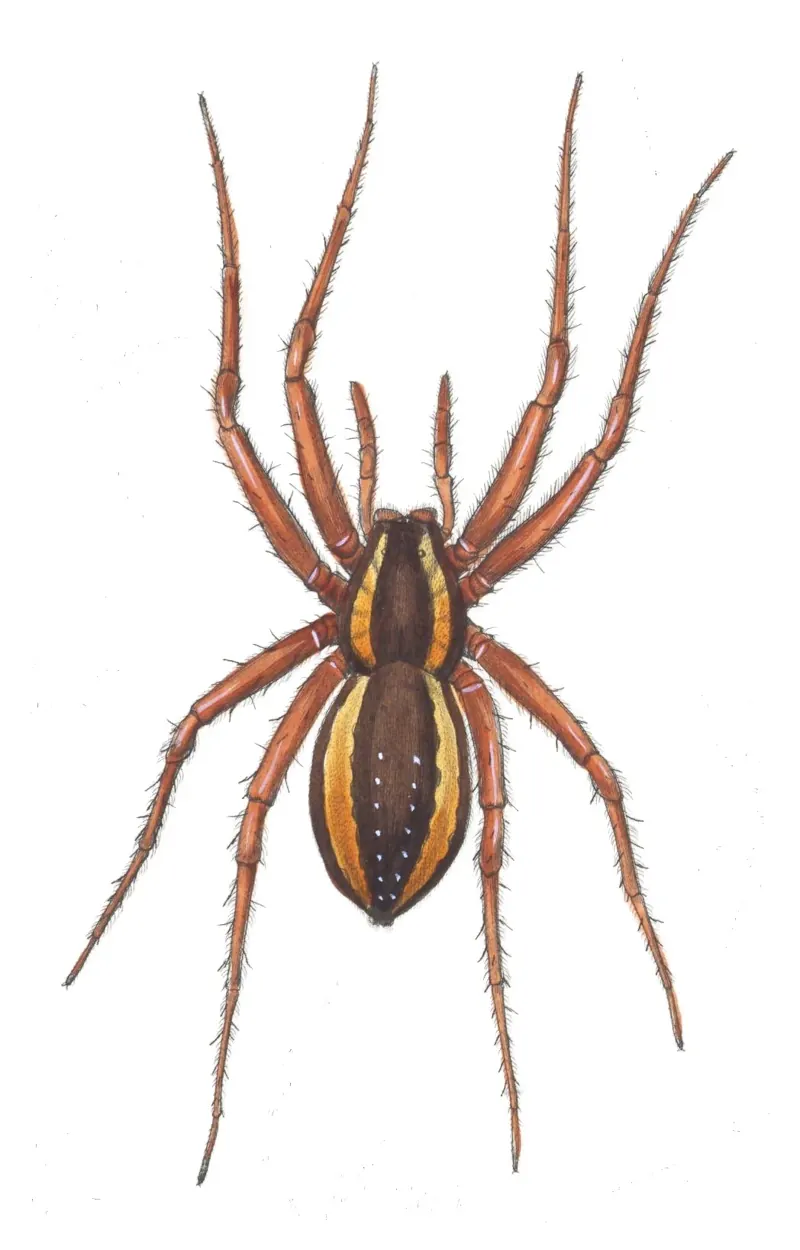
Spider classifications have relied heavily on Eugène Simon, who published in France in the late 19th century. Britannica: Spider (spiderwebs and classification) Fewer than 30% of the large spiders of tropical America are known, compared with 80% or more of species in northern and central Europe. Britannica: Spider (spiderwebs and classification) · checked 30 Oct 2026
Darwin’s bark spider (Caerostris darwini) is a Madagascan orb weaver, named as a new species in 2010. Agnarsson, Kuntner & Blackledge 2010, PLoS ONE (peer-reviewed): Darwin’s bark spider silk
Darwin’s puzzle
On the voyage of HMS Beagle, Darwin wondered how spiders could land on the ship far out at sea and take off again on windless days. University of Bristol, 5 July 2018: Spiders go ballooning on electric fields In 2018, University of Bristol scientists showed that money spiders can take off on electric fields like those in the air, even with no wind at all. University of Bristol, 5 July 2018: Spiders go ballooning on electric fields
Spiders at work for us
Spider venom and silk are used in research, in insect-specific pest control and in fibre technology. Australian Museum: Spiders British spiders catch and eat many of the insects that bother us, such as houseflies, midges and wasps, and help stop farm pests building up. British Arachnological Society factsheet: Essential spider info