Trappers, ambushers, jumpers and swimmers
Not every spider waits in a web. Some chase, some pounce, some fish and one throws a net.
Spiders hunt in many ways: trapping, stalking and jumping on prey, or hiding to ambush it. Australian Museum: Spiders Spider venom works on the nerves of insects and other prey, stopping them moving. It also helps break down the prey’s body. Australian Museum: Prey capture and feeding
Ambush
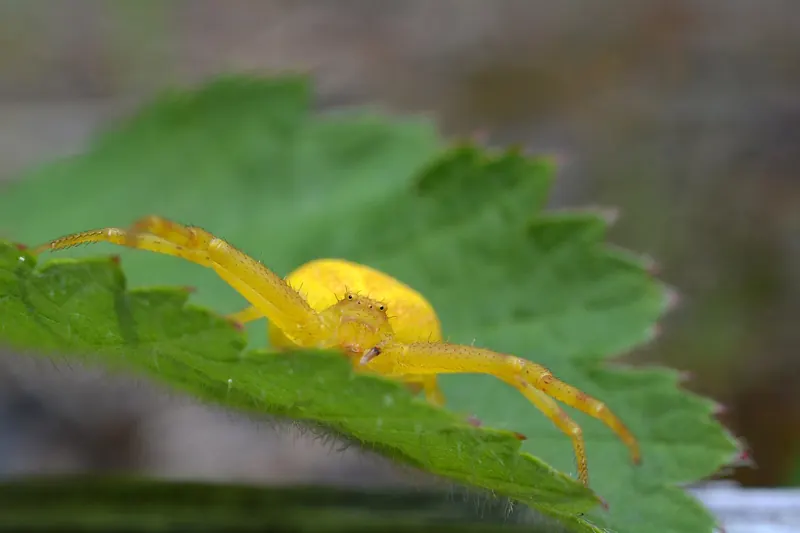
The flower crab spider doesn’t spin a web. It waits on plants to ambush bees, moths and other insects that come to feed on flowers. The Wildlife Trusts: Flower crab spider The female can change colour to match her surroundings; the much smaller male can’t. The Wildlife Trusts: Flower crab spider
Crab spiders are named for their crab-like front legs and their ability to run sideways. The Wildlife Trusts: Flower crab spider
Jumpers
Jumping spiders can leap more than 20 times their own body length, pushed off by their back legs. Australian Museum: How spiders see the world Jumping spiders hunt by day, using excellent eyesight to spot prey and recognise mates. Australian Museum: How spiders see the world
The zebra spider is a black-and-white striped jumping spider 6 to 7 mm long. It can jump up to 10 cm, over 14 times its own body length. The Wildlife Trusts: Zebra spider
- Jumping spiders are the largest spider family, with more than 6,000 species. Britannica: Spider (spiderwebs and classification) · checked 30 Oct 2026
- The Wildlife Trusts gives more than 5,000 jumping spider species. The Wildlife Trusts: Zebra spider · checked 30 Oct 2026
Both sources agree jumping spiders are a huge family; they give different round figures. Every disagreement we found →
Runners
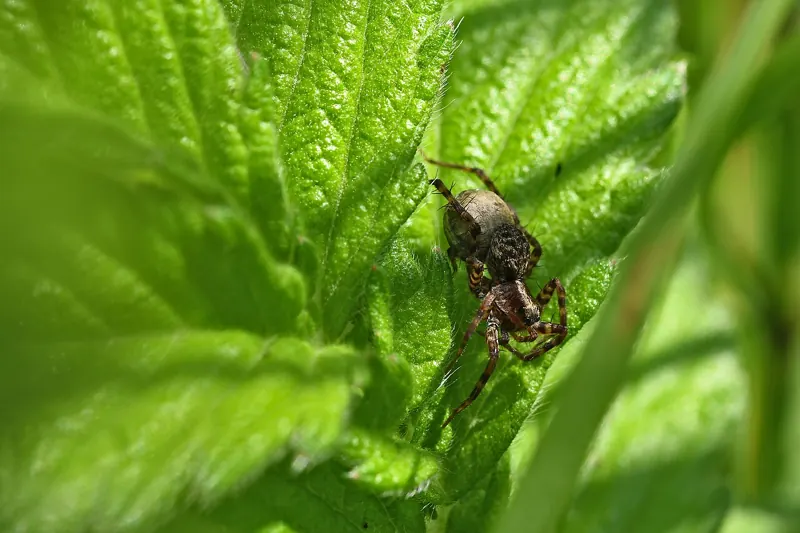
Wolf spiders hunt on the ground by day, chasing prey down and leaping on it. The Wildlife Trusts: Wolf spider At night, wolf spiders’ eyes shine brightly in torchlight. Australian Museum: How spiders see the world
There’s much more on these runners, including why most of them can only be named under a microscope, on the wolf spiders page.
On and under water
The raft spider rests its front legs on the water to feel for prey, then runs out across the surface. It even catches tadpoles and small fish. The Wildlife Trusts: Raft spider Raft spiders can swim underwater, and often dive when threatened. The Wildlife Trusts: Raft spider
One species from Europe and Asia, the water spider, is truly aquatic, living in slow-moving fresh water. Britannica: Spider (size and distribution) A few spiders live along shores or on the surface of fresh or salt water. Britannica: Spider (size and distribution)
Odd techniques
Spitting spiders catch prey with a well-aimed squirt. Britannica: Spider (spiderwebs and classification) Net-casting spiders hold a small web between their four front legs and throw it over passing insects at night. Britannica: Spider (spiderwebs and classification)
In October 2024, the Ellan Vannin Invertebrate Group found the pirate spider Ero furcata in the grounds of Government House, Onchan. It specialises in eating other spiders, and is one of two Ero species found on the island so far. Manx Wildlife Trust: Ellan Vannin Invertebrate Group field report, Government House grounds, Onchan, 19 October 2024
Staying alive
Many spiders hide by looking like bark, leaves, twigs, bird droppings or even ants. Australian Museum: Spiders Others escape by dropping on a silk line, playing dead or showing warning colours. Australian Museum: Spiders
A spider grabbed by a predator can drop a leg. Young spiders can grow it back at their next moult. Australian Museum: Spiders The golden wheel spider of Namibia escapes danger by cartwheeling down sand dunes, spinning 44 times a second. Britannica: Spider (size and distribution)
Pest controllers
British spiders catch and eat many of the insects that bother us, such as houseflies, midges and wasps, and help stop farm pests building up. British Arachnological Society factsheet: Essential spider info The Natural History Museum calls spiders useful, eco-friendly pest controllers in our towns and cities. Natural History Museum, London: Spiders in your home
The Australian Museum puts it simply: spiders ‘stop insects taking over the world’. Australian Museum: Spiders Over 800 spiders can be found in a single square metre of grassland. British Arachnological Society factsheet: Essential spider info
Next: bites, calmly →