Wolf spiders: the runners
No web, just speed and big eyes. You can usually tell a wolf spider as a family at a glance. Telling one species from another is a different story.
Wolf spiders (family Lycosidae) are a large family of more than 2,300 species in 135 genera, named for the way they chase and pounce on prey. Britannica: Wolf spider · checked 30 Oct 2026 About 240 kinds of wolf spider live in North America and about 50 in Europe, and many live north of the Arctic Circle, on the tundra. Britannica: Wolf spider · checked 30 Oct 2026
How to tell a wolf spider
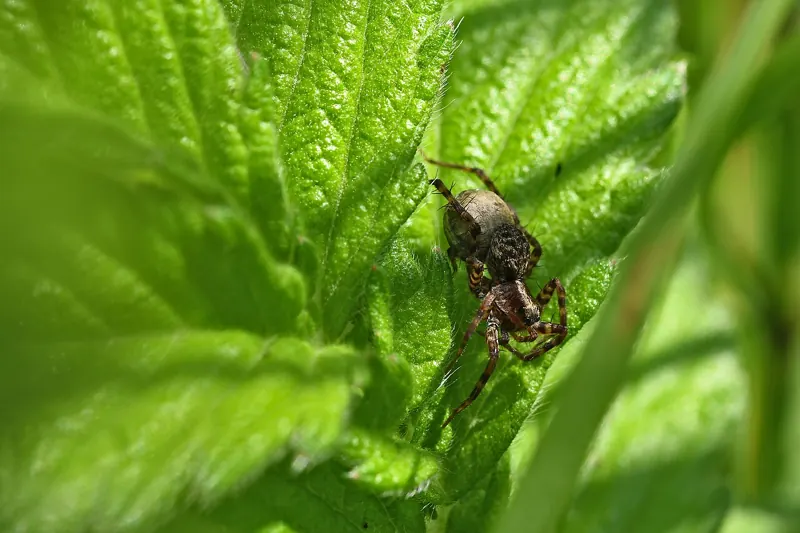
Wolf spiders are easy to recognise as a family by their eyes: four small eyes in the bottom row, two very large eyes in the middle row and two smaller eyes on top. Britannica: Wolf spider Most wolf spiders are dark brown, small to medium sized, with a long, hairy body and stout, long legs built for running. Britannica: Wolf spider
Wolf spiders hunt on the ground by day, chasing prey down and leaping on it. The Wildlife Trusts: Wolf spider Many wolf spiders are most active at night or when the sky is overcast. Britannica: Wolf spider
Most wolf spiders build silk-lined tube nests in the ground; some hide the entrance and others build a little turret over it. Only a few species spin webs. Britannica: Wolf spider
Mothers that carry everything
A female wolf spider carries her egg sac attached to her spinnerets, then carries the young on her back for a few days. The Wildlife Trusts: Wolf spider Carrying the egg sac on the spinnerets is unique to wolf spiders. After hatching, the spiderlings ride on their mother’s back for several days to weeks. Britannica: Wolf spider
- A female wolf spider carries her egg sac attached to her spinnerets, then carries the young on her back for a few days. The Wildlife Trusts: Wolf spider
- Carrying the egg sac on the spinnerets is unique to wolf spiders. After hatching, the spiderlings ride on their mother’s back for several days to weeks. Britannica: Wolf spider
The Wildlife Trusts describes the common UK Pardosa amentata; Britannica covers the whole family, so its wider range is not a contradiction. Every disagreement we found →
Wolf spiders in Britain
The UK wolf spider The Wildlife Trusts profiles, Pardosa amentata, has a body 6–8 mm long, is common and widespread, and is seen from March to July, often sunbathing or running across the ground. The Wildlife Trusts: Wolf spider
The Wildlife Trusts says there are several species of wolf spider that are very difficult to tell apart. The Wildlife Trusts: Wolf spider The British Arachnological Society’s 2019 checklist lists British and Irish wolf spiders in nine genera: Pardosa, Hygrolycosa, Xerolycosa, Alopecosa, Trochosa, Arctosa, Pirata, Piratula and Aulonia. Lavery 2019, A revised checklist of the spiders of Great Britain and Ireland, Arachnology 18(3) (British Arachnological Society)
Can you name one from a photo?
Usually only so far. A spider workshop handout from the British Arachnological Society says most British spiders need a microscope for a reliable species identification, and any identification made without one should be treated as tentative. British Arachnological Society: spider workshop handouts (Geoff Oxford) The same handout says that, with experience, every spider can be identified in the field to family, and the vast majority to genus. British Arachnological Society: spider workshop handouts (Geoff Oxford)
To be certain of most species, experts compare the male’s palps or the female’s epigyne (reproductive parts) under a microscope with drawings in specialist guides. British Arachnological Society leaflet: How to study spiders
Even experts find wolf spiders hard: in 2004 the arachnologist Peter Harvey reported that he had named Pardosa lugubris as its close relative Pardosa saltans the year before, despite checking it against the published drawings. Harvey 2004, Pardosa lugubris sensu stricto in Britain, SRS News 50 (British Arachnological Society)
Even the names can move: in 2019 a review proposed that the British Alopecosa barbipes should be called Alopecosa accentuata, but this was reversed in 2022, and Alopecosa barbipes is the name the World Spider Catalog now accepts. Lavery 2025, The spiders of Great Britain and Ireland checklist, Arachnology 20(3) (British Arachnological Society) · checked 30 Oct 2026
So on this site we say “a wolf spider” or name the genus where a source supports it. Some genera have features you can see: Thin-legged wolf spiders (Pardosa) have relatively long legs with long spines on the ‘foot’, and a lens-shaped greenish or grey egg sac. Britannica: Wolf spider Pirata wolf spiders, often found near ponds or streams, have a pale V-shaped mark on the back. Britannica: Wolf spider
If you’d like a species name for a find, the British Arachnological Society is the place to start.
Around the world
The wolf spiders with the biggest bodies mostly belong to the genus Lycosa, which includes Lycosa tarentula of southern Europe. Britannica: Wolf spider The name ‘tarantula’ first belonged to this wolf spider, Lycosa tarentula, and comes from the town of Taranto in Italy. Britannica: Tarantula
People once believed its bite caused ‘tarantism’, a wild dance (the tarantella is named after it). It has been shown that its bite is not dangerous to people. Britannica: Tarantula Lycosa tarentula has a body about 2.5 cm long. Like other wolf spiders, it spins no web and catches prey by chasing it. Britannica: Tarantula
Burrowing wolf spiders (Geolycosa) spend most of their lives in burrows and dig with their heavy front legs. Britannica: Wolf spider
Wolf spiders in trouble
One of the largest wolf spiders, Hogna ingens, lives only on Deserta Grande in the Madeira Islands and is critically endangered. Its body is about 2.5 cm long, with legs about the same length. Britannica: Wolf spider · checked 30 Oct 2026
Two wolf spiders found only on Saint Helena, the snarling wolf spider (Lycosa ringens) and the cunning wolf spider (Dolocosa dolosa), are listed as endangered on the IUCN Red List. Britannica: Wolf spider · checked 30 Oct 2026